

The blue sapphire gemstone is one of the most beautiful stones of all. Consecutively, it is not surprising that there is always a high demand for this stone, and people want to use it for astrological purposes or to wear it as an ornament or jewelry. However, if you buy them, you must determine the stone’s authenticity.
Only natural stone can provide you with the astrological benefits you seek.
Whether you’re seeking astrological benefits or simply want to adorn yourself with a stunning piece, a natural blue sapphire is a valuable investment. On the other hand, if you’re looking for a more budget-friendly option, a synthetic blue sapphire may be the way to go.
You need to note that the primary difference between natural and synthetic sapphire is its origin. This comprehensive guide will cover the history, properties, identification methods, and practical tips to help you discern the genuine from the synthetic.
Introduction to Sapphires
Sapphires are a variety of the mineral corundum, composed primarily of aluminum oxide. They are most commonly known for their blue color, but sapphires can be found in various colors, including pink, yellow, green, and even colorless. Trace elements such as iron, titanium, chromium, copper, or magnesium give sapphires their distinct hues.
The Appeal of Sapphires
- Durability: Sapphires score a 9 on the Mohs scale of hardness, making them second only to diamonds in terms of durability.
- Brilliance and Luster: High-quality sapphires exhibit a stunning brilliance and luster that make them highly sought after.
- Symbolism and Use: Historically, sapphires have been associated with royalty and used in various types of jewelry, including engagement rings, earrings, and necklaces.
Natural vs. Synthetic Sapphires
Natural sapphires are mined from the earth and formed under high-pressure and high-temperature conditions for millions of years. On the other hand, synthetic sapphires are created in laboratories using various methods to replicate the natural conditions that form sapphires. While both types are chemically identical, there are differences in their formation, inclusion patterns, and other physical properties.
Historical Context of Synthetic Sapphires
French chemist Auguste Verneuil achieved the first successful synthesis of sapphires in 1902 using the flame fusion process. This method allowed the production of large quantities of synthetic sapphires, making them more accessible and affordable. Since then, other methods, such as the Czochralski process, hydrothermal synthesis, and flux growth, have been developed to produce synthetic sapphires with varying qualities and characteristics.
Identifying Synthetic Sapphires
Identifying synthetic sapphires involves a combination of visual inspection, gemological tests, and advanced scientific techniques. Here are some key factors and methods used in the identification process:
1. Visual Inspection
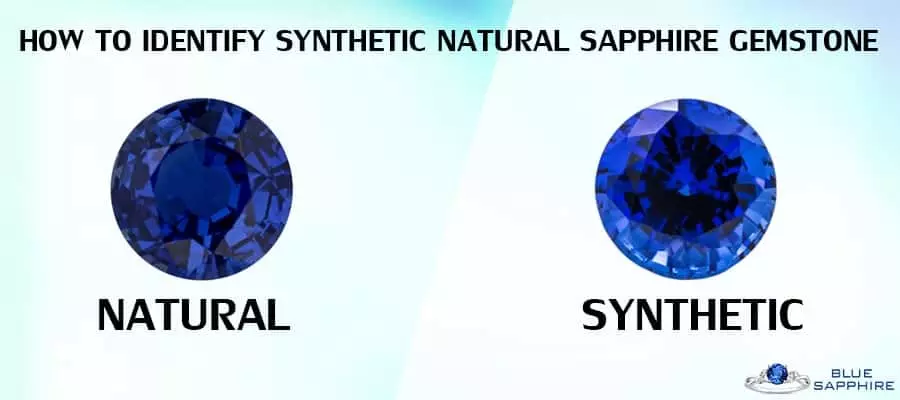
Color and Clarity: Synthetic sapphires often have a more uniform color and fewer inclusions than natural sapphires. Natural sapphires typically have color zoning and a range of inclusions unique to their formation process.
Growth Patterns: Synthetic sapphires created using the flame fusion method, a process known for its precision, often show curved growth lines, while natural sapphires exhibit straight or angular growth lines.
2. Inclusions
Inclusions are materials trapped within a gemstone during its formation. They can provide valuable clues about the origin of the sapphire.
Natural Inclusions:
- Needles and Rutiles: Fine needle-like inclusions, often in intersecting patterns.
- Mineral Crystals: Small crystals of other minerals.
- Zoning: Color zoning is due to the uneven distribution of trace elements.
Synthetic Inclusions:
- Gas Bubbles: Round or oval-shaped gas bubbles, common in flame fusion sapphires.
- Curved Striae: Curved growth lines not found in natural sapphires.
3. Refractive Index and Specific Gravity
Refractive Index (RI): Both natural and synthetic sapphires have a similar RI range (1.762-1.770). However, slight variations can sometimes be detected using precise instruments.
Specific Gravity (SG): Sapphires have a specific gravity of approximately 4.00. Differences can be subtle, but accurate measurements can help identify them.
4. Spectroscopic Analysis
Spectroscopy involves analyzing a gemstone’s light absorption and emission patterns. Due to variations in trace element content and distribution, natural and synthetic sapphires can exhibit different spectroscopic signatures.
UV-Vis Spectroscopy: Can reveal absorption features indicative of natural or synthetic origins. Raman Spectroscopy: Can help identify the internal structure and inclusions within the sapphire.
5. Advanced Testing Methods
Luminescence: Synthetic sapphires may exhibit different luminescence under UV light compared to natural sapphires.
X-Ray Diffraction: Provides detailed information about the crystal structure, which can help distinguish between natural and synthetic sapphires.
Practical Tips for Gemstone Buyers
- Buy from Reputable Sources: Purchase sapphires from reputable jewelers and dealers who provide certification from recognized gemological laboratories.
- Request Certification: Always ask for a certificate of authenticity from a recognized gemological institute.
- Educate Yourself: Learn about the different types of sapphires, their properties, and common identification methods.
- Use a Loupe: Carry a jeweler’s loupe (10x magnification) to inspect sapphires for inclusions and growth patterns.
- Seek Expert Advice: Consult with a certified gemologist if you are unsure about the authenticity of a sapphire.
Distinguishing between natural and synthetic sapphires can be challenging but is crucial for making informed purchasing decisions. By understanding the differences in formation, inclusion patterns, and physical properties and using a combination of visual inspection, gemological tests, and advanced scientific techniques, you can confidently identify synthetic sapphires. Whether adding to your collection or investing in fine jewelry, these insights will help you select genuine, high-quality sapphires.
Frequently Asked Questions:
1. What is a synthetic sapphire?
A synthetic sapphire is a gemstone created in a laboratory that has the same chemical composition, crystal structure, and physical properties as a natural sapphire but is not formed naturally.
2. What are the main differences between synthetic and natural sapphires?
Origin: Natural sapphires are formed over millions of years in the earth’s crust, while synthetic sapphires are created in laboratories.
Inclusions: Natural sapphires usually have inclusions or tiny imperfections, while synthetic sapphires tend to have fewer or more uniform inclusions.
Growth Patterns: Natural sapphires exhibit natural growth patterns, while synthetic sapphires may show curved growth lines or other signs of artificial growth
3. How can inclusions help identify a natural sapphire?
Natural sapphires often contain inclusions such as:
- Mineral crystals
- Fingerprint-like inclusions
- Silk (fine rutile needles)
These inclusions are usually irregular and randomly distributed.
4. What tools can gemologists use to identify synthetic sapphires?
- Magnification: Using a loupe or microscope to inspect inclusions and growth patterns.
- Spectroscope: To analyze the light spectrum absorbed by the gemstone.
- UV Light: Some synthetic sapphires may fluoresce differently under UV light than natural ones.
- Refractometer: To measure the refractive index, which should be consistent for natural sapphires but may vary slightly in synthetics due to the manufacturing process.
5. Can the color of a sapphire indicate if it’s synthetic or natural?
Not directly. Both synthetic and natural sapphires can exhibit a wide range of colors. However, very vibrant and uniform colors might indicate an artificial origin, as natural sapphires typically have color zoning or variations.
6. Do synthetic sapphires have different values compared to natural sapphires?
Yes, synthetic sapphires are generally less valuable than natural sapphires due to their artificial origin. However, they can be an attractive option for those seeking high-quality gemstones at a lower price.
Such a nice post. Thanks to the author for sharing with us such information about Blue Sapphire. Very informative, I came here to know about shippher and that is what I got!!
I bought a blue sapphire ring in Australia. The stones are in 14 carat gold. A cluster of small ones and one in the center. How will I know the authenticity. Only thing it is too small to wear on the center finger. What do I do. I paid 250 Australin dollars
Firstly the authenticity of a gemstone can be verified through its gem certificate. Secondly, if it is too small to wear on the center finger then you can visit any local jeweler and fit it according to the size of your center finger because for blue sapphire center finger is perfect.